
The NWCF celebrates awardees at . . . That Pottery Thing. . . 2025
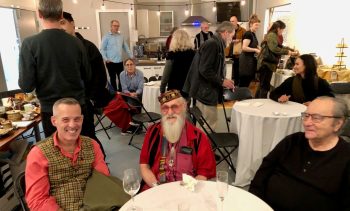
TPT 2025 attendees. At front, left to right, Dave Carlin, John David Lawrence, and Frank Turco
The North West Ceramics Foundation held their award ceremony, . . . That Pottery Thing. . . 2025, on December 4, at the Mayer Studio, 1000 Parker St, in Vancouver. Refreshments were provided by Noble Egg Catering run by fellow ceramicist Nicole Guillemin and featured a wide range of tasty finger food. Prosecco, wine, and beer were also available. Attendees included previous award-winners, donors, curators, and supporters. All were present to celebrate recipients of the NWCF Mayer Wosk Award of Excellence and two new awards, the Tam Irving Honorary Award of Recognition (“The Tam”) and the Celia Rice-Jones Legacy Award (“The Celia”). In addition to snacks and awards, attendees were privy to a silent auction of beautiful works by some of BC’s best ceramic artists, including works by the award recipients. A small table of mugs, plates, and decorative items from the collection of Sally Michener offered visitors inexpensive souvenirs of this beloved former teacher and artist.
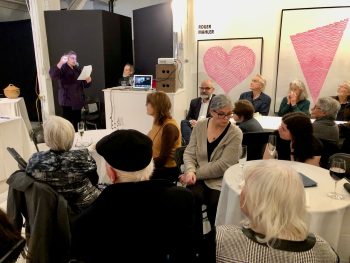
NWCF president Debra Sloan introduces the evening
NWCF president Debra Sloan started off the evening greeting visitors and outlining activities undertaken by the Foundation over the past several years, including support for the newly funded ceramic residency at the UBC Museum of Anthropology, the Speakers Series, bursaries, and scholarships awarded to post-secondary students. Board member Martin Peters introduced two new awards and asked Keith Rice-Jones, the initiator of the Celia award, to speak a little about his wife for whom the award is named. Martin then introduced the awardee, Alan Burgess, who presented a well-illustrated talk detailing his life and work in clay. His career began in Britain, surprisingly, as a student of Celia among others at the Camberwell School of Art in London, and continued half a world away on the coast of British Columbia. Martin then asked Tam Irving, for whom the Tam is named, to introduce the awardee D’Arcy Margesson, whose long career in ceramics includes developing a popular earthenware clay body and teaching the complications of glaze chemistry to generations of students. D’Arcy also made a short presentation that featured beautiful flowers he grows in combination with his lovely pots.
Board member Ying-Yueh Chuang introduced the NWCF Mayer Wosk Award, which this year was presented to two outstanding artists, Amelia Butcher and Wei Cheng. Both Amelia and Wei presented short talks about their practices, which emphasized their engagement with the material in poetic and highly personal ways. The evening concluded with the closing of the silent auction and conversation among the happy and satisfied guests.
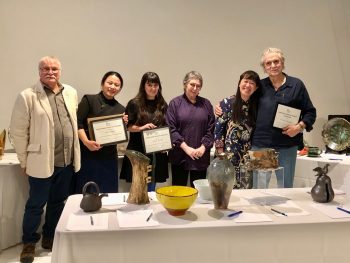
Award winners left to right: Alan Burgess, Wei Cheng, Amelia Butcher, Debra Sloan (NWCF), Ying-Yueh Chuang (NWCF), and D’Arcy Margesson
It is a great privilege to recognize and celebrate the wonderful artists whose extensive and diverse practices contribute so fruitfully to the excellence of ceramics in our province. We are forever grateful to our donors and supporters who make this important work possible.
Debra Sloan publishes on Bill Rennie
 The North West Ceramics Foundation is very pleased to have supported the publishing of a new monograph written by Debra Evelyn Sloan, Bill Rennie: His Realms and Havens: Architectural Marvels Realized in Clay. Bill Rennie (1953 – 2015) was one of Vancouver’s most charismatic ceramic artists, and it is an important part of the NWCF mandate to support publications addressing the history and culture of BC Ceramics.
Sloan addresses a number of aspects of Rennie’s life and practice including his growing up in Surrey, his activism, drawings, and unique architectural fantasies. Her work draws on personal memories—she first met the artist when both were students at the Vancouver School of Art in 1979. Bill was, if anything, unconventional in his practice, and much of his treasured legacy was scattered and poorly recorded. Along with friends and supporters including Donna Hagerman, his sister Marigrace Rennie, Jeannie Mah, Sally Michener, John David Lawrence, and others, Sloan collected, organized, and documented his amazing archive of letters, drawings, proposals, reminisces, diary entries—all written in his distinctive, block-letter style–and surviving works.
What emerges with this book is a compelling story of a gifted if often contrarian artist who was deeply engaged with the artistic and social issues of his day. His work was influenced by popular art movements including Funk and Dada, and by social issues such as AIDS/gay rights, the live/work studio and housing movement, gentrification, and funding for the arts in Canada.
His intricate architectural works were often accompanied by elaborate, narrated drawings, which give insight into his process. He built his structures using combinations of press-moulding, sprigs, hand-forming, carving, and assembling. He often accepted, even welcomed, collapse and distortion from the action of the kiln through multiple firings. Although many of his early works paid close attention to actual historical structures, his mature work blossomed with fantasy and his remarkable imagination. Numerous images provide examples of his work, with many works newly photographed by his long-time friend Donna Hagerman.
Drawing on archives, personal memories, historical and contemporary photographs, and the artist’s writings, Bill Rennie: His Realms and Havens: Architectural Marvels Realized in Clay provides an essential guide to a unique, unconventional, and deeply creative maker of masterful ceramic sculpture. Debra Sloan’s long experience as a recorder of BC ceramics history, her personal knowledge of the artist, and her clear passion for her subject make this a book that will carry far into the future.
Bill Rennie: His Realms and Havens: Architectural Marvels Realized in Clay, by Debra Evelyn Sloan, is published by Sassamatt Publications, and available through Amazon.
Remembering Jinny Whitehead
 It was with great sadness that we learned of the passing of Jinny Whitehead on September 25, 2025. Jinny was a tremendous catalyst and friend of our community in Vancouver. From 2003 – 2004, she served as the vice president of the Potters Guild of BC, and, from 2005 – 2012, the president. She served on the Board of the North West Ceramics Foundation from 2004 to 2012. In 2021, The NWCF hosted an event, That Pottery Thing …, with a room dedicated to Jinny in recognition of her many contributions and ceramic practice.
Jinny was born in Calcutta, India, to a family that had lived there for 3 generations. She was raised in the UK, immigrated in 1985 to Ontario, where she served as the Executive Assistant to the first head of Canada’s new security and intelligence agency (CSIS). She and her husband Gordon moved to Vancouver in 1995. She became involved with local potters, and, together with Pia Sillem and Joan Barnet, formed Studio 3, which worked out of the Mergatroid Building in Vancouver’s east side. A self-taught potter, she attended workshops and wood-fire conferences for many years, eventually building a wood-fire kiln with her friends in Lund, on the Sunshine Coast. Her handsome, hand-built vessels were created slowly and mindfully and often included found pieces of driftwood. Her work was exhibited in numerous exhibitions including In the Palm of the Hand, a BC/Japan exchange exhibition in Tajimi, Japan; Ashes to Art at Crane Arts, in Philadelphia and By Hand at the Museum of Vancouver in 2010. In 2018, The Guiding Hand, featuring her wood-fired vessels, was the final exhibition at the Gallery of BC Ceramics on Granville Island. Speaking about her work, the artist said:
Years of travelling and living in different countries have exposed me to an array of cultures. My creations fuse this awareness with a fascination for and love of natural forms–factors that inform the essential character of my work.
In 2005, she guided the PGBC through their 50th Anniversary, organizing celebrations, events, and exhibitions across the province. The year concluded with a catalogued exhibition, Transformations, at the Burnaby Art Gallery, curated by Dr. Carol E. Mayer, Darrin Martens, and Hiro Urakami.
 In 2011, she worked with Linda Lewis and Debra Sloan to digitize and post the PGBC’s historical newsletters dating back to 1965. The newsletters are searchable and can be found on the UBC History Digital Program website here .
Sheila Morrissette worked closely with Jinny on the Guild’s Gallery Committee and on the Guild’s Board of Directors. She remembers Jinny as follows:
Jinny was an amazing president for the Guild. She led with thoughtfulness, sincerity, and transparency, always keeping the needs of the organization at the forefront and dedicating countless hours to the task, at the expense of time lost for work in her own studio. Hers were hard shoes to fill when she stepped down. I stayed on the Board for an additional year to help ease the transition but Jinny was always unfailingly available for help and advice.
Sadly, ill health took its toll, and Jinny was forced to retire from her studio in 2018. A much-loved and appreciated member of the ceramics community, she made a real difference to ceramics in our province. She will be long be remembered and greatly missed.
Vancouver Potter Inspired by Korean Jars
Board member Martin Peters will have an exhibition of Big Jars from the 17th to the 25th of October, 2025, at the Enishi Gallery, 269 East 6th Avenue, Vancouver. A reception will be held on October 17th at 7pm.
Martin Peters is inspired by large Korean jars known as onngi in his own work. He has created his own Big Jars in his studio in the Dunbar neighborhood of Vancouver.
The exhibition will be held at the Enishi Gallery adjacent to the Japanese store Itsumo in Vancouver. Martin has recently been travelling in the Orient where he was inspired by Korean onngis. These big Korean Jars are traditionally used for the preparation and storage of food. The big jars have been central to the Korean culture for centuries. Mr. Peters’ work evokes the grandeur and silence that emanates from these big pots. 
For further information please contact Martin Peters at 604-202-6832; by email: jmartinpeters@gmail.com or our web site: dunbarpottery.com.
Former Board Member Tam Irving awarded the Order of Canada

Tam Irving in his studio gallery
The North West Ceramics Foundation is thrilled with the appointment of former Board Member Tam Irving to the Order of Canada on June 30, 2025, by Her Excellency the Right Honourable Mary Simon, Governor General of Canada. One of Canada’s highest honours, the Order of Canada recognizes people across all sectors of society who have made extraordinary and sustained contributions to our nation.
The description of the achievements of Thomas Peter Caven Irving, known to us as Tam, on the official website are quite minimal:
Tam Irving is a traditional studio potter who championed the use of local materials and created glazes by crushing rocks with his studio machines. After sculpting for three decades, he transitioned into three-dimensional still-life compositions and painting. Professor emeritus at Emily Carr University of Art and Design, he has exhibited his work internationally.
However, we all know that his achievements as an artist and outstanding human being far exceed this cursory description. Quoting for our letter of support for his nomination, we write:
Tam Irving’s outstanding achievement over a lifetime is well-documented in his numerous exhibitions, writings, and presentations dating back as far as 1966. His work has been the subject of essays and catalogues written by noted scholars in Canada and the US. His first solo exhibition was held at the New Design Gallery in Vancouver in 1966. More recent solo exhibitions include Transitions of a Still Life, at the Burnaby Art Gallery in 2007; and Stillness and New Direction in Ceramics at VisualSpace Gallery in Vancouver in 2020 and 2021. Tam Irving’s functional and sculptural ceramics have been included in group exhibitions of note in Canada from 1967 until the present including A Question of Identity: Twelve Canadians at the Clay and Glass Gallery, Waterloo, ON, in 1998; Thrown, at the Belkin Art Gallery, UBC, in 2004; and Modern in the Making: Post-War Craft and Design in British Columbia at the Vancouver Art Gallery in 2020-2021. His work resides in significant public and private collections across Canada and abroad.
In selflessly sharing his immense knowledge through his teaching, writing, presentations, and exhibitions, Tam Irving has done much to promote the importance of ceramics in Canada, and the importance of Canadian ceramics to the world. In this, he has served the nation, proving to the world that Canada’s creative output stands alongside that of any other nation on an international scale. About his functional work, noted potter and theoretician Paul Mathieu has written, “It compares with anybody in the world making that type of work. . .. In my opinion, there are maybe 50 serious potters in the world that I know of and Tam is one of them.” Through his outstanding work, his technical and artistic innovations, his teaching, and his example, Tam Irving is fully deserving on the Order of Canada, which recognizes the best our nation has to offer to the world.
Well done Tam!! We are pleased and proud that the jury recognized what we have known all along, that you are an outstanding and essential member of the creative community of Canada.
UBC MOA Artist Residency

Judy Chartrand, Métis Soup, 2019, MOA Collections 389/1 a-t Photo Alina Ilyasova.
The North West Ceramics Foundation is very pleased to announce an excellent opportunity, which we have the great pleasure to support. We invite all ceramic artists to consider this unique residency sponsored by the UBC Museum of Anthropology. For more information, please see their website.
The UBC Museum of Anthropology invites applications for the Ceramic Artist-in-Residence, a four-month residency program running annually from May to September. Specific start dates are flexible and will be determined in consultation with the successful applicant.
This residency is open to practising ceramic artists interested in exploring how MOA’s world-renowned collections can inform and inspire their practice. The selected artist will have access to the Judy Cranmer Ceramics Research Laboratory, located within the Museum’s Multiversity Galleries, and will engage with MOA’s collections, exhibitions and public programming as appropriate.
The artist-in-residence will receive:
• An honorarium of $2,000
• On-campus parking during the residency period
• The opportunity to make work available for sale in the MOA Shop
As this is an experimental residency, applicants should note that there are no on-site kiln facilities, and the studio has limited dust extraction capabilities. Artists are encouraged to consider these constraints in their proposals.
This residency is generously supported by the North West Ceramics Foundation (NWCF) and Carol E. Mayer.
________________________________________
How to Apply
Interested applicants must submit the following materials:
• A current resume
• A portfolio (including images of recent work)
• A cover letter outlining artistic goals, areas of interest, educational background and specific requirements for participation in the residency
Applications should be submitted via email to:
Mitiana Arbon
Curator, Pacific + Ceramics
Email: mitiana.arbon@ubc.ca
Applications will be reviewed by Mitiana Arbon and a representative from the North-West Ceramics Foundation. The successful candidate will be notified upon final approval by MOA’s Management Committee.
Deadline: April 15, 2025
Announcement: The successful applicant will be notified by email by the end of April.
Dr. Carol E. Mayer announced as recipient of the Robert Jekyll Award

Dr. Carol E. Mayer
The NWCF is thrilled to announce that our founding and continuing Board Member, Carol Mayer, has received the Robert Jekyll Award for Leadership in Craft. Well done Carol!!! Please see the Craft Federation announcement below:
Dr. Carol E. Mayer Honoured for Her Contributions to Canadian Craft
The Canadian Crafts Federation (CCF/FCMA) is thrilled to announce Dr. Carol E. Mayer as the 2024 Laureate of the Robert Jekyll Award for Leadership in Craft. This prestigious award honours Dr. Mayer’s remarkable dedication to advancing Canadian craft as an anthropologist, curator, advocate, and volunteer.
For more than 35 years, Dr. Mayer has made significant contributions to ceramics curation, research, and public engagement in Canada. Her journey in the field began in the 1970s at the Museum of Vancouver, where she served as Curator of Decorative Arts. In 1987, Dr. Mayer was invited to join the University of British Columbia’s (UBC) Museum of Anthropology (MOA), where she served as Senior Curator (Pacific & Ceramics). During her time at MOA, she oversaw the museum’s international ceramics collection, which includes over 2,000 pieces. She worked closely with potters to understand the technical aspects of their craft, translating this information into a wealth of expertise in ceramics curation. Dr. Mayer has shared her knowledge in publications such as The Potter’s Art (UBC Press, 1997) and Made of Clay: Ceramics of British Columbia (D&M, 1998).
In 2015, she furthered UBC’s engagement with the ceramic arts by establishing the Judy Cranmer Ceramic Lab, a residency program that has supported ceramicists from across Canada. Today, Dr. Mayer is a Research Fellow in Ceramics at MOA, where she leads the “From the Land” project, exploring the history and evolution of ceramics in British Columbia.
In addition to her curatorial work, Dr. Mayer is the founding President of the North-West Ceramics Foundation (NWCF), where she has served on the Board for over 30 years. Through her leadership, she has played a pivotal role in establishing scholarships, awards, residencies, and endowments in support of ceramicists. Notably, she launched the NWCF Award of Excellence, as well as two Awards of Recognition for emerging and senior potters, and a national award for critical writing on Canadian ceramics.
“As both a paid professional and volunteer, she uses her unique position, resources, and skills to raise the status and appreciation of ceramics. Students, practitioners, collectors, museums, galleries, and the public benefit from her indefatigable endeavours.” – Amy Gogarty
In 2023, Dr. Mayer was honoured with the Citizen of Craft Award by the Craft Council of BC. With this latest recognition, her outstanding achievements are being celebrated once again with the Robert Jekyll Award for Leadership in Craft. This award highlights distinguished individuals who have made lasting contributions to the craft sector, and Dr. Mayer is a most deserving recipient.
The CCF/FCMA extends its heartfelt congratulations to Dr. Carol E. Mayer for her exceptional work and lasting impact on the craft community in Canada. We also congratulate all of this year’s nominees for their outstanding contributions, including the 2024 Robert Jekyll Award shortlist: Melanie Egan, Susan Ferneaux, and Alain Piroir.
The Dusty and Gutsy Babes at Medalta

Tranquil stream by Medalta
Following up on her excellent account of her time at Medalta–sponsored, in part, by a NWCF Maureen Wright Bursary— Heather Lippold has sent us an additional report that captures the combined experience of her collective, The Dusty and Gutsy Babes. A number of Babes have received support from the NWCF in the past, and we are thrilled to cheer on their success. The members of this collective represent the very best of a new generation of ceramic artists in BC! Below please find the collective account of their residency.
. . . . . . . . . . . . . . . . . . . . . . . . . . . . . . . .
In June and July 2024, our collective, The Dusty and Gusty Babes, participated in a six-week residency at Medalta’s historic Clay District in Medicine Hat, Alberta. This group included Kristine Aguilar, Amelia Butcher, Angela Hopkins, Chrystal Johnson, Heather Lippold, Tony Wilson, and Sam Knopp. The residency centered on the theme of scavenging—a concept that resonates deeply with each of us in unique ways. Together, we explored materials sourced from the natural world, urban environments, and our personal histories, using this shared curiosity as a foundation for material experimentation, collaboration, and creative growth.

Amelia Butcher shard test
We began the residency by focusing on material testing, a process that became the foundation for much of our work. Arriving with an eclectic assortment of materials, we used the idea of a “scavenger’s encyclopedia” as a catalyst for our tests. These materials ranged from wood ash, volcanic minerals, and local shale to expired iron pills, silica gel packs, laptop wiring, oyster shells, eggshells, playa dust from burning man and shards from our collective’s past projects. Some of these shards were an homage to the legacy of Don Hutchinson’s studio in White Rock, where many of us had shared his old space. While this collection might have been overwhelming for one person to tackle, it became a manageable and exciting group endeavor, transforming what could have been chaos into an inspiring collaborative experiment.
The residency unfolded with an ever-shifting dynamic as each of us cycled in and out of the studio, treating the space like a clay hot desk. Half calculated research, half mad scientist. Over the six weeks, we completed four soda firings, six firings in the Blaauw and more test kilns than we can remember. The rhythm of the residency was intense yet rewarding: make, bisque, glaze, fire, grind, repeat. Many of us discovered new rhythms in our practice, whether working by day or late into the night. The arid Alberta air was a shared challenge—we often joked about whose skin was driest, with our hands resembling the cracked earth outside the studio’s brick walls, which we also scooped up to test. The constant application of lotion became as much a part of our process as wedging clay.

Angela Hopkins glaze tests
As a group, we each brought unique goals and perspectives, yet found common ground through shared experimentation and inspiration. Whether rediscovering clay after time away, refining surface treatments, developing glazes with scavenged materials, or repurposing shards from past projects, our collective focus on exploration and growth unified our efforts. The collaborative environment at Medalta allowed us to learn from each other, deepen our practices, and amplify our individual pursuits.
The residency was not just a period of artistic growth but also one of mutual support and inspiration. We left with new ideas, new skills, and a deeper appreciation for the power of collaboration in the ceramic arts.
Heather Lippold and the Dusty Babes at Medalta

Clay and Material samples, Heather Lippold
The North West Ceramics Foundation recently received a detailed report from Heather Lippold, a recipient of a Maureen Wright Bursary to attend a six-week residency in 2024 at the Medalta International Artist in Residence Program (MIAR) in Medicine Hat, Alberta. She was joined in the residency with members of the Dusty Babes Collective, who cycled in and out during the time. Heather was able to attend for the full six weeks, which gave her an excellent opportunity to develop her work. What follows is an edited version of her report, illustrated with tests produced by members of the Collective during the residency.
Heather wrote:

Group calcining tests
While at this residency I was able to take part in four soda firings and six gas kiln firings with folks in our collective. Throughout the six weeks , seven of us cycled in and out of Medalta. The advantage of having a group of us working on different material exploration was our ability to learn not only from our own results but also from each other. It also allowed us to commit to so many firings.
The first few weeks started with initial testing. I had brought with me a variety of wood ashes from the community, expired iron pills, laptop wiring, scrap metal shavings, copper carb (made from recycled laptop copper), oyster shells, eggshells, clays, silica gel packs. This time was exploratory and allowed us all to get a bit weird while researching what was happening with the different materials. The materials we had as a group for this “scavengers encyclopedia” would have been too much for one person to test.
The remaining weeks were focused on producing work for the soda and gas kilns to test surfaces and glazes and applying initial tests. My primary focus shifted to testing ash glazes with the ingredients I had scavenged from wood stoves and pits. I produced my own copper carb by oxidizing the copper wire I salvaged from my home and the recycling depot. I was able to produce a decent amount of work to showcase mine and others test results.

Cone Ten tests
My time at Medalta really let me dive into testing. Not having the resources to do that frequently in my current living situation was invaluable. Exploring the idea of the “scavenged” material really gave me more control over where the materials in my work come from. Learning to work with what you have in abundance rather than a scarcity mindset was one of my biggest takeaways.
It is one of the biggest pleasures of our Board that we are able to assist BC ceramicists in following their dreams and investing in their careers. Seeing the advances made by Heather Lippold and other members of the Dusty Babes Collective encourages us in our work all the more. We look forward to seeing how this experience contributes to their new work.
For more on the Maureen Wright Bursary, please see here.
Robin DuPont Wins the BC Achievement Award for Applied Art and Design
 Robin DuPont, winner of the 2021 NWCF Mayer Wosk Award of Excellence, has just received the BC Achievement Award for Applied Art and Design. The NWCF would like to take this opportunity to congratulate Robin on this prestigious award.
Robin DuPont is a frontrunner in contemporary ceramics in North America, recognized for his innovative atmospherically fired ceramics that push the boundaries of form and surface. With over 20 years of experience, Robin’s pursuit of creative and technical development has earned him a reputation for excellence in the field. His extensive research into new ceramic surfaces, clay bodies, and kiln design sets him apart in Canadian studio ceramics.
As an educator and mentor, Robin has taught at numerous institutions across Canada and the United States, and currently leads the ceramics program at Kootenay Studio Arts at Selkirk College. His teaching has reinvigorated the program, inspiring the next generation of potters to produce work of exceptional quality. Robin also conducts workshops from his property in the Slocan Valley, sharing his expertise in atmospheric firing.
Congratulations Robin DuPont!


